A website is often described as a place where a brand is “applied”. That makes the website sound like a finished container waiting for a logo, colour palette and typeface to be dropped into it. In practice, the relationship should be much closer.
The brand defines how the business should be understood. The website has to communicate that position, organise the information, prove the promise and move a potential customer towards a decision. Those are not separate jobs.
Designing both together does not mean making every project bigger than it needs to be. It means making the important decisions in the right order and ensuring that the identity can survive outside a presentation deck.
The brand and website are two parts of the same customer experience.
Your brand is not only the logo. It includes the position you occupy, the language you use, the expectations you set and the visual signals that help people recognise you. Your website is where many of those elements meet for the first time.
A visitor does not separate the experience into “brand work” and “web work”. They judge the whole thing at once. The headline, imagery, navigation, proof, tone and visual quality combine to answer a simple question: does this business feel right for me?
Brand creates the expectation. The website has to make that expectation believable.
When the two are disconnected, the website may look competent while communicating the wrong personality, or the identity may look distinctive in isolation but become difficult to use across real pages and content.
One clear position gives both projects a stronger starting point.
Website projects become difficult when the business has not decided what it wants to be known for. Every page then tries to say everything, every audience receives equal priority and design decisions are made according to taste rather than purpose.
Brand strategy should establish the useful foundations first:
- The customers the business most wants to attract.
- The problems it is best placed to solve.
- The difference it can credibly own.
- The impression it needs to create.
- The evidence that supports its claims.
Those decisions immediately improve the website. They influence the sitemap, the homepage hierarchy, which services deserve dedicated pages, what proof should appear early and which calls to action make sense.
The brand direction also becomes more disciplined because it is being tested against a commercial use case rather than judged only as a collection of attractive visual assets.
Messaging should guide the page structure—not be squeezed into it afterwards.
A common workflow is to design a set of pages using placeholder text, then ask the business to “add the copy”. This often creates awkward results. Headlines are forced into spaces that were designed for shorter phrases. Important explanations are removed because the layout cannot accommodate them. Calls to action become generic because the customer journey was never considered.
When brand messaging and website structure develop together, the design can respond to the real content. A strong positioning statement can define the hero. Customer concerns can become section headings. Proof can be placed immediately after the claims it supports.
The result is not simply better copy.
It is a better interface. The page feels easier to follow because the visual hierarchy and verbal hierarchy are doing the same job. Design is helping the message land, rather than competing with it.
A brand identity becomes stronger when it is tested across a real website.
A logo can look excellent on a single mockup and still be awkward in practice. It may be too detailed at navigation size, too wide for mobile headers or dependent on a colour combination that does not provide enough contrast.
The same applies to the wider identity. A typeface may be expressive in large headlines but tiring in long paragraphs. A palette may look distinctive in a brand board but lack enough tones for forms, alerts, hover states, backgrounds and accessible text. An image style may feel compelling until the business needs fifty consistent photographs rather than three selected examples.
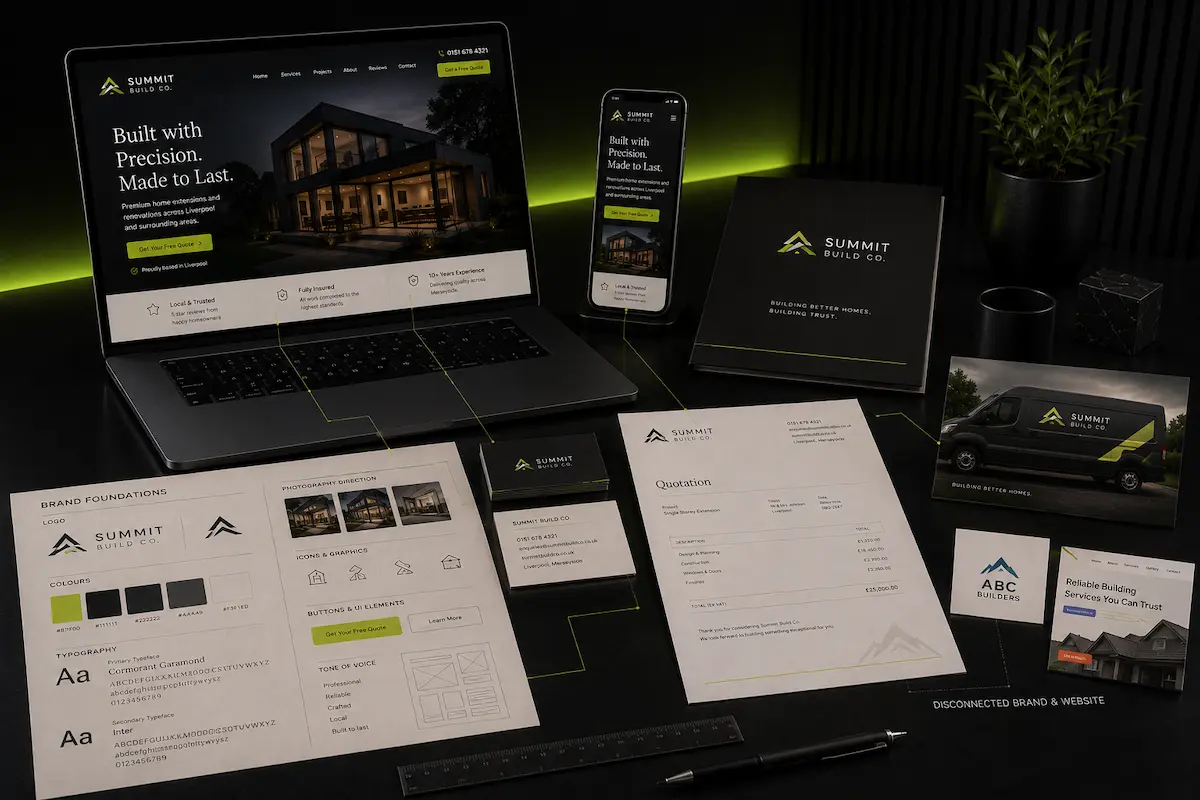
Developing the website alongside the identity exposes these issues early. The system can be refined while it is still flexible, producing a brand that is not only recognisable but genuinely usable.
Consistency should extend beyond matching colours and fonts.
A joined-up brand and website does not mean every page is covered in branded decoration. The deeper consistency is behavioural. The way the website communicates and functions should support the same qualities the identity claims.
A premium brand needs more than an expensive-looking typeface. It needs careful pacing, restrained motion, considered photography and a low-friction enquiry process. A direct, practical service brand should not hide essential information behind abstract language and overcomplicated interactions.
The website looks related to the identity, but the message and experience may still feel generic.
What the business says, shows and asks the customer to do feels like one coherent experience.
The second form is what creates a stronger impression. It makes the business feel intentional rather than merely styled.
A connected process removes avoidable compromises.
Separate projects often create handover problems. The website designer receives a logo but no clear messaging system. The brand designer creates assets without knowing how the website will be structured. The developer is asked to reproduce layouts that do not account for responsive behaviour or content management.
These gaps create additional rounds of decision-making and can lead to:
- Reworking the colour palette to meet accessibility requirements.
- Creating missing icon, image and layout styles halfway through development.
- Rewriting copy because the brand message does not fit the page structure.
- Compromising the identity to fit a preselected website template.
- Duplicating discovery work across multiple suppliers.
A joined-up process is not automatically faster, but it is usually more efficient. Decisions are made once, with awareness of how they affect the whole system.
Consistency reduces doubt and makes the business easier to trust.
Customers rarely analyse why a business feels credible. They notice whether the experience is clear, current and consistent. Small contradictions—an informal social presence leading to a corporate website, old branding mixed with a new identity, different terminology across pages—create friction even when the customer cannot name the problem.
Consistency signals control. It suggests that the business understands what it offers and pays attention to the details of how customers experience it.
This is especially important for service businesses because the customer is often buying something they cannot inspect in advance. The website and brand have to reduce uncertainty before a conversation begins.
Search visibility is more valuable when the brand converts the attention it earns.
SEO and branding are sometimes treated as opposing priorities: one focused on search engines, the other on perception. In a well-planned website they support each other.
Search research helps reveal the language customers use, the services they care about and the questions that delay a decision. Brand strategy determines how the business should answer those questions differently and credibly.
The website can then create pages that are both discoverable and distinctive. Service pages address clear search intent without reading like interchangeable SEO copy. Location relevance is supported with genuine evidence rather than repetitive place-name paragraphs. Titles and headings describe the offer accurately while still sounding like the business.
Traffic alone is not the goal. The goal is to attract relevant people and give them a convincing reason to choose you.
Brand and website do not always need to be rebuilt at the same time.
Designing together is valuable, but a combined project is not always necessary. An established business may already have a clear, flexible identity and only need a stronger website. A recent website may perform well while the logo and supporting visual system require refinement.
Separate projects can work when:
- The existing brand position is clear and still commercially relevant.
- Useful guidelines and production-ready assets already exist.
- The website structure can accommodate the planned identity changes.
- Messaging is consistent and agreed before design begins.
- The scope is deliberately limited rather than separated by accident.
The risk comes from pretending the two are independent when one clearly limits the other. A new website cannot fully solve unclear positioning. A new identity cannot repair a confusing customer journey.
How to brief a combined brand and website project.
A productive brief should explain the commercial change the business wants to create—not only list visual deliverables. Give the designer enough context to connect perception with performance.
State the business goal. Explain what needs to improve: better-fit enquiries, higher-value work, clearer services, a new market or stronger credibility.
Define priority customers. Identify who the website needs to persuade first rather than describing the audience as everyone.
Share what already works. Existing recognition, search rankings, customer language and useful content should not be discarded without reason.
Collect real proof. Projects, testimonials, results, accreditations, process details and photography give both the brand and website something credible to build around.
Plan content ownership. Decide who will write, approve and maintain the website content before the project stalls around empty pages.
Agree the rollout. Consider social profiles, documents, vehicles, signage, email and other touchpoints that need to change alongside the website launch.
The strongest outcome is a working system.
The final deliverable should not be a logo in one folder and a website in another. It should be a connected set of decisions that helps the business communicate consistently wherever a customer encounters it.