Most visitors do not arrive ready to carefully study every page. They scan, compare and decide whether the business feels relevant, credible and worth contacting.
That gives the homepage a demanding job. It must orientate a new visitor, show them that they are in the right place and provide enough evidence to make a next step feel sensible.
A homepage does not need every piece of information about the business. It needs the right information in the right order. The sections below form a strong foundation for most trades, professional services and local service companies.
A clear opening message.
The first screen should answer three basic questions almost immediately: what does the business do, who is it for and where does it operate?
Many homepages waste this space on broad claims such as “quality you can trust” or “solutions tailored to you”. These statements sound safe, but they do not tell a visitor whether the company provides the service they need.
Specialist brickwork, extensions and structural repairs for homeowners across Liverpool and Merseyside.
The message does not need to explain everything. It only needs to make the business understandable enough that the visitor wants to continue.
A specific service offer.
A visitor should not have to translate internal company language into a practical result. Describe services using the terms customers recognise and connect them to the problems those customers are trying to solve.
Specificity is usually more convincing than scale. A smaller company that clearly explains its expertise can feel more credible than a business attempting to present itself as the answer to everything.
- Name the core service categories clearly.
- Use customer language rather than internal terminology.
- Show the type of client or project that is the strongest fit.
- Avoid filling the first screen with every secondary service.
A homepage should reduce the amount of guessing required from the customer.
Immediate proof that the business is credible.
Customers are naturally cautious, especially when a project involves access to their home, a meaningful budget or an ongoing commercial relationship. Trust should not be confined to a testimonial section near the bottom of the page.
Use an early trust strip or compact proof area to surface the strongest reassurance available. Depending on the business, this might include:
- Years of experience or number of completed projects.
- Insurance, qualifications, memberships or accreditations.
- Review score and number of verified reviews.
- Areas served and typical response times.
- Recognisable clients, partners or product manufacturers.
The strongest proof is specific and verifiable. “Trusted by customers” is weak. “Rated 4.9 from 86 verified reviews” gives the visitor something concrete to assess.
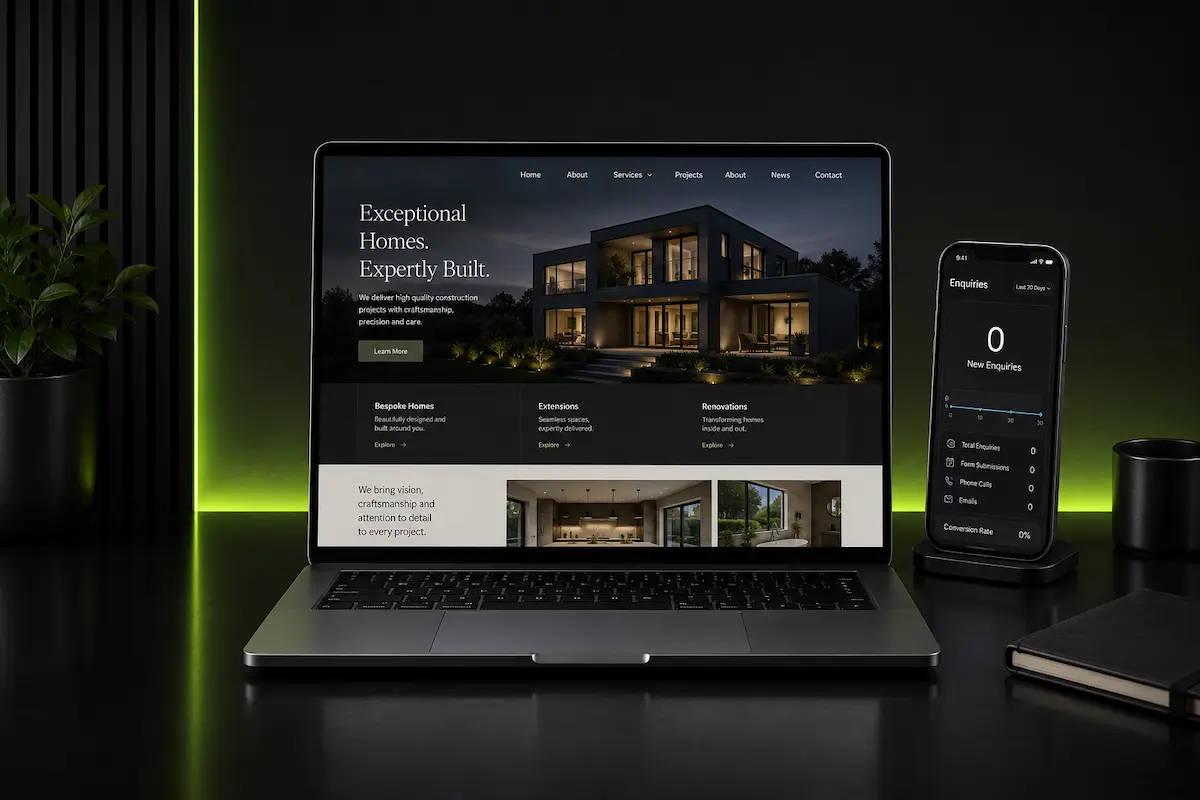
A focused overview of the main services.
The homepage should help visitors find the most relevant route without presenting a wall of equal-looking options. Prioritise the services that matter most commercially and give each one a short, useful explanation.
Each service card or row should ideally include a clear name, one-sentence description and a link to a dedicated service page. Dedicated pages can then explain the process, common project types, relevant proof and frequently asked questions in more depth.
This structure is useful for customers and search engines. The homepage establishes the overall offer while individual pages create stronger relevance for specific services.
A simple explanation of how the service works.
Uncertainty prevents enquiries. A short process section helps visitors understand what happens after they make contact and makes the service feel more organised.
Keep the process honest and straightforward. For many service businesses, three to five stages are enough:
- Initial enquiry or consultation.
- Site visit, audit or discovery.
- Proposal, quotation or agreed scope.
- Delivery of the work.
- Handover, support or follow-up.
A process section is not there to make a simple service look complicated. Its purpose is to make the next step feel predictable.
Relevant examples of completed work.
Project photography and case studies allow visitors to judge the quality of the work for themselves. The most useful examples are not necessarily the most visually dramatic; they are the ones that closely resemble the type of project the business wants more of.
Where possible, add context. A gallery image becomes more persuasive when the visitor can understand the challenge, the service provided and the result.
Show outcomes, not only images.
A short project description can explain why a particular approach was used, how disruption was managed or what changed for the customer. This transforms a generic gallery into evidence of judgement and capability.
Reviews that support the promises being made.
Testimonials work best when they confirm the qualities the website claims. If the business promises clear communication, dependable timescales and careful workmanship, the selected reviews should provide evidence of those points.
Avoid presenting reviews as anonymous marketing copy. Include the customer’s name, project type, location or review platform where permission allows. A link to the full third-party review profile can provide additional confidence.
Choose a small number of strong, detailed reviews rather than filling the page with repetitive one-line praise.
The areas the business genuinely serves.
For a local service business, location matters. The homepage should state the primary area clearly and naturally mention the wider service region where relevant.
This helps visitors confirm availability and gives search engines useful context. It should not become a long list of locations inserted purely for keywords. The wording needs to remain useful and believable.
Based in Maghull and completing brickwork projects across Liverpool, Sefton and the surrounding Merseyside area.
Businesses serving multiple important locations may benefit from dedicated location pages, but only when those pages contain genuinely useful and distinct information.
FAQs based on real customer concerns.
A useful FAQ section should answer questions that regularly slow down an enquiry. This might include pricing approach, timescales, service area, availability, guarantees, required preparation or what information is needed for a quote.
Avoid adding obvious questions simply to make the section look complete. The best questions are often the ones customers repeatedly ask by phone, email or during an initial consultation.
Clear answers help the visitor self-qualify and can reduce time spent handling unsuitable enquiries.
A clear and realistic next step.
The homepage should end by telling the visitor what to do next. “Contact us” is functional, but a more specific call to action can reduce uncertainty:
- Request a quotation.
- Book an initial consultation.
- Discuss your project.
- Arrange a site visit.
- Check availability.
The contact route should suit the way the business actually operates. A simple form, email address and telephone number are often enough. Asking for too much information too early can create unnecessary resistance.
Repeat the main action consistently.
The primary call to action should appear at logical points throughout the page using consistent language. Multiple contradictory actions—book, buy, subscribe, download, call and request a quote—can dilute attention.