For a service business, local SEO is the work of helping the right people find, understand and trust the business when they search for a service in a particular area.
The website is only one part of that system, but it is the part you control most directly. It should support the same information shown in the Google Business Profile, explain each important service properly, demonstrate real experience and remove technical barriers that stop pages being discovered or understood.
These are foundations rather than shortcuts. They do not guarantee a particular ranking, and they cannot change how far the searcher is from the business. They give Google and potential customers clearer evidence of relevance and credibility.
Understand what local SEO is actually trying to achieve.
Google describes local results in terms of relevance, distance and prominence. Relevance is how closely the business matches the search. Distance is how far the business is from the searcher or the location used in the query. Prominence reflects how well known and well supported the business appears across reviews, links and other information.
A website can strengthen relevance and prominence. It cannot make a Liverpool business physically closer to someone searching in Manchester. This matters because local SEO should improve the signals the business can control rather than promising blanket number-one rankings across every nearby town.
Make it unmistakably clear what the business does, where it genuinely works and why a local customer should trust it.
That clarity should exist across the website, Business Profile, external listings and customer proof. When those elements contradict each other, the business becomes harder to interpret.
Give important services and locations a clear place in the website.
A single homepage cannot explain every service in enough depth. When all services are compressed into a few short cards, there is little information for a customer to evaluate and little page-level relevance for a search engine to understand.
Build the navigation and page structure around the real offer. A brickwork company might need separate pages for extensions, garden walls, structural repairs and repointing. A cleaning business may need commercial cleaning, communal areas, end-of-tenancy and short-let turnaround pages.
- Create a dedicated page for each commercially important service.
- Group closely related minor services rather than producing dozens of thin pages.
- Link service pages from the main navigation, homepage and relevant project content.
- Use human-readable URLs that describe the subject clearly.
- Make the principal service and operating area clear on the homepage.
The structure should follow how customers make decisions, not a spreadsheet of every keyword variation.
Local relevance comes from clear information—not from repeating a postcode until the page becomes unreadable.
Align the website with a complete, accurate Business Profile.
For many local searches, the Google Business Profile is as important as the website. It can appear in Maps, the local pack and branded search results before a customer reaches the site.
The profile should be verified and completed with the correct primary category, relevant secondary categories, phone number, website, opening hours, service areas, services, description, photos and other applicable details. Information should reflect the real business rather than being expanded to chase unrelated searches.
The website should reinforce the same core facts. If the profile describes a roofing contractor in Liverpool but the website presents a general property company with no clear location, the connection is weak. The wording does not need to be identical, but the identity, offer and location should agree.
Keep special hours and operational changes updated. A technically optimised site cannot compensate for a profile that sends customers to the wrong number or says the business is open when it is not.
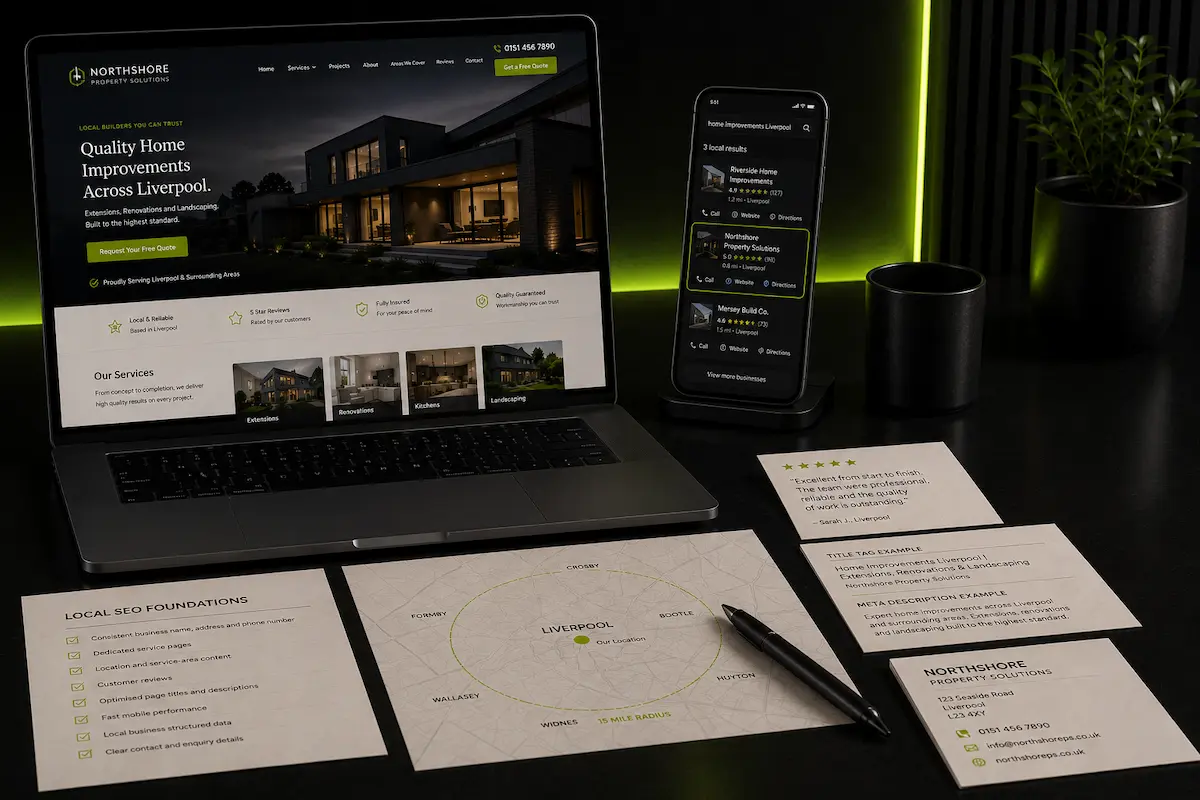
Keep the core business details accurate everywhere.
The business name, phone number, address where applicable, service area and website should be presented consistently across the site and major profiles. This is often referred to as NAP consistency: name, address and phone number.
Consistency is not about forcing every directory to use identical punctuation. It is about avoiding meaningful conflicts: old telephone numbers, former addresses, duplicate profiles, several business names or different websites attached to the same company.
Put reliable contact details in obvious places such as the footer and contact page. Add the trading name and registered details where legally required. For a service-area business that does not receive customers at its premises, follow Google’s rules rather than publishing a residential address simply to target a town.
Audit the most visible third-party profiles and directories, prioritising quality and accuracy over the number of listings created.
Create service pages that answer real buying questions.
A useful service page does more than state that the service exists. It helps a prospective customer decide whether the business is suitable and gives search engines enough context to understand the page.
Explain the service in practical terms.
Describe the types of work covered, common situations, the process, materials or methods where relevant, expected outcomes and any limits. Use the language customers use naturally without forcing exact-match phrases into every sentence.
Show evidence connected to that service.
Add genuine project examples, before-and-after images, relevant testimonials, qualifications, guarantees and answers to frequent questions. Generic claims such as “high quality” become more credible when supported by specific evidence.
Make the next step obvious.
Every service page should provide a clear route to enquire, call, request a quote or view related work. Search visibility has little commercial value when the page leaves the customer unsure what to do next.
Use location pages only when they provide genuine local value.
Location pages can be useful when a business serves several important areas and can provide meaningful information for each one. They become weak when the same generic paragraph is duplicated dozens of times with only the town name replaced.
Google’s spam policies warn against doorway pages created mainly to rank for similar searches and funnel users to the same destination. A responsible location page should have a real purpose for someone in that area.
- Explain which services are genuinely available there.
- Include relevant projects, photographs or testimonials from the area where possible.
- Describe practical coverage, travel or response information accurately.
- Answer area-specific questions rather than repeating the main service page.
- Only create pages for locations the business can realistically serve.
Several strong area pages are more useful than fifty near-identical pages that exist only for search engines.
Get the basic on-page signals right.
Each important page should have one clear subject. The page title, main heading, introduction, body content, image descriptions and internal links should support that subject without becoming repetitive.
Write a concise title that identifies the service and, where useful, the principal location. Create a distinct meta description that gives the searcher a reason to click. Google may rewrite titles and snippets, but clear source information still improves the chance of a useful result.
Use one descriptive main heading and a logical hierarchy of subheadings. Link between related services, projects, location pages and articles using anchor text that tells people what they will find.
“Click here” gives little context. “View our garden wall projects” explains the destination to both the reader and the crawler.
Do not add a hidden block of town names or repeat the same keyword unnaturally. On-page optimisation should improve comprehension, not damage it.
Remove technical barriers before chasing more content.
Search engines need to access, render and understand the pages. Customers need those pages to load and work properly on the device they are using.
- Serve the site securely over HTTPS.
- Use responsive layouts with readable text and usable controls on mobile.
- Optimise images, fonts, scripts and video so important content is not delayed unnecessarily.
- Use real crawlable links rather than relying on interactions a crawler may not follow.
- Create an XML sitemap containing the canonical, indexable pages and submit it through Search Console.
- Use robots.txt carefully so important pages and assets are not blocked.
- Add canonical URLs to clarify preferred versions where duplicate URLs can occur.
- Fix broken links, redirect retired pages and provide a useful 404 page.
A sitemap is a discovery hint, not a command that forces indexing. Robots.txt controls crawling, not whether a previously discovered URL can appear in search. These tools are valuable, but only when used for the job they actually perform.
LocalBusiness and Organisation structured data can help Google understand business details. It should accurately reflect visible page content and be tested after deployment. Schema is not a substitute for useful content and does not guarantee a rich result or higher ranking.
Build prominence with genuine proof, reviews and local relationships.
Local search is not won entirely inside the website. Google considers information about the business from across the web, including links and reviews. Customers use the same signals when deciding who appears established and trustworthy.
Create a simple, repeatable process for asking real customers for honest reviews. Do not buy reviews, offer prohibited incentives or filter requests so only happy customers can respond. Reply professionally to positive and negative feedback.
Earn relevant local mentions through work that deserves them: supplier relationships, trade associations, community activity, local press, sponsorships, professional memberships and partnerships. A link from a genuine organisation connected to the business is more valuable than a bulk package of unrelated directory links.
Bring that proof back onto the website through project case studies, named testimonials where permission exists, accreditations and clear examples of work completed in the service area.
Measure enquiries and visibility—not just ranking screenshots.
Rankings vary by location, device, personalisation and time. A single screenshot is not a reliable measure of whether local SEO is generating business.
Connect Google Search Console to understand which queries and pages produce impressions and clicks. Use analytics to measure landing-page behaviour and completed actions. Review Business Profile performance for calls, website clicks, direction requests and other available interactions.
Most importantly, record actual enquiries and their source. A smaller number of relevant visits that produce qualified work is more valuable than a large increase in traffic from people outside the service area.
Once the foundations are stable, ongoing work becomes easier to prioritise. Improve pages already receiving impressions, add stronger proof, answer recurring customer questions and expand only where the business has genuine capability.
Sources and further reading.
This guide is informed by current official Google Search Central and Google Business Profile documentation: