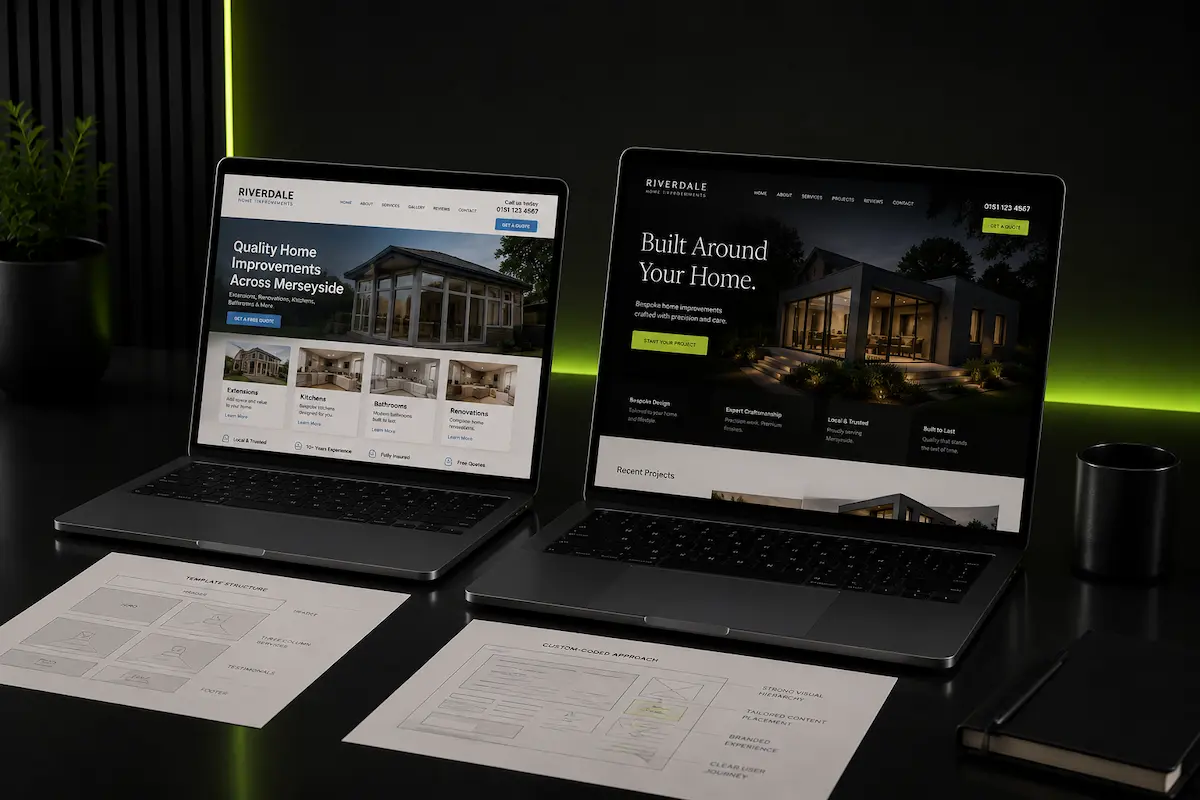
“Custom-coded” and “template” are often used as shorthand for good and bad. That is an unhelpful way to judge a website. A poorly planned custom build can waste money, while a carefully configured template can serve a straightforward business perfectly well.
The useful differences appear in how much control the project needs, how distinctive the business should feel, what functionality is required and how the site must evolve after launch.
For a service business, the right choice is the one that supports the commercial goal without paying for complexity that will never be used—or accepting limitations that will become expensive later.
It is not a choice between “professional” and “unprofessional”.
There are excellent and poor examples of both approaches. The build method does not determine whether the offer is clear, the copy is convincing, the photography is credible or the customer journey makes sense.
A website can be completely custom and still fail because it was designed around visual novelty rather than customer needs. A template can look generic because it was left almost untouched, but that is an execution problem rather than proof that every template is unsuitable.
Do not ask which label sounds more premium. Ask which approach gives this business the right balance of clarity, distinction, speed, flexibility and cost.
The commercial objective should come first. The technology should follow.
What a template website actually is.
A template provides a pre-existing foundation for the layout or underlying system. That may be a WordPress theme, a Webflow template, a Shopify theme, a hosted website builder or a reusable component library created by a developer.
The amount of customisation varies enormously. At one end, a business swaps the logo, colours and photographs into a ready-made demo. At the other, a designer uses a reliable framework but rebuilds the structure, styling and content around the business.
- Templates can reduce initial design and development time.
- Established platforms may make routine editing easier for internal teams.
- Common functions such as blogs, shops and booking systems may already be available.
- The quality depends heavily on the theme, plugins, customisation and person implementing it.
A template becomes a problem when its limitations begin dictating the customer experience, rather than the business requirements shaping the site.
The platform matters, but the decisions made on top of it matter more.
What custom-coded should mean.
A custom-coded website is designed and developed around a specific set of requirements rather than fitted into a pre-made page design. The structure, visual system, responsive behaviour and interactions can be created without inheriting the assumptions of a theme.
That does not mean every line must be invented from nothing. Professional developers still use established languages, libraries, patterns and tested components. Reusing reliable methods is good engineering. The value lies in controlling what is included and how it works.
A genuine custom build should provide:
- A page structure based on the customer journey rather than template availability.
- A visual system that reflects the brand instead of resembling the theme demonstration.
- Only the code and features that the site actually needs.
- Responsive behaviour planned for the content rather than patched in afterwards.
“Custom-coded” is only meaningful when that extra control improves the final result. It should not be used as a decorative sales phrase.
Performance depends on what is loaded—not the label on the quote.
Custom websites often have a performance advantage because unnecessary features, theme files and plugins can be avoided. A focused site with optimised assets and a small codebase is easier to keep fast.
However, custom code can still be slow when images are oversized, animation is excessive or the development is careless. Templates can also perform well when the theme is lean, the hosting is suitable and optional features are controlled.
Look beyond a broad promise of speed. The important questions are practical:
- How many external scripts, plugins and font files are required?
- Are images sized, compressed and loaded appropriately?
- Does the site remain responsive on an ordinary mobile connection?
- Can updates be made without gradually adding more technical weight?
The best build is not the one that wins a theoretical argument. It is the one that gives real visitors a fast, stable experience.
Design control matters when the business needs to feel distinct.
Templates are designed to suit many businesses. That is exactly why they can be useful, but it also means their default layouts tend to rely on familiar patterns. When several local competitors use similar themes, changing the colour rarely creates a recognisable brand.
Custom design allows the hierarchy, proportions, typography, image treatment and interaction to express a particular position. That control is valuable when perception affects the price a business can command, the type of client it attracts or the trust it needs to build.
Not every business needs an experimental interface. Distinction usually comes from a few disciplined decisions applied consistently—not from making every element unusual.
When the website needs to communicate a specific market position, support an established identity or present work in a way that standard theme sections cannot achieve without compromise.
Flexibility includes the people maintaining the site.
A bespoke front end can provide precise control, but the editing experience also matters. A business that publishes weekly articles, changes products daily or has several internal editors may benefit from a mature content management system.
Custom design and content management are not opposites. A website can have a fully bespoke interface connected to a CMS. Equally, a static custom site may be the cleanest option for a small service business whose pages change only occasionally.
The right setup depends on the actual workflow:
- Who will update the site after launch?
- Which content needs to change regularly?
- How much control should editors have over layouts?
- Could unrestricted editing gradually damage consistency?
More editing freedom is not always better. The goal is enough control to keep information current without making the system fragile or difficult to use.
Neither approach guarantees SEO or accessibility.
Search performance depends on useful content, sensible page architecture, crawlability, metadata, internal links, performance and authority. Accessibility depends on semantic structure, keyboard support, contrast, labels and considered interaction.
A custom build can make these foundations easier to control. A reputable template may already include many of them. Both can also be implemented badly.
Be cautious when “SEO included” means only installing a plugin or filling in a title field. The platform can provide controls, but someone still needs to make good decisions about the pages, topics and customer intent.
The same applies to accessibility. Passing responsibility to a theme does not remove the need to test the final website with its real content and interactions.
Compare lifetime cost, not only the launch price.
Templates usually reduce the initial investment because part of the design and development work has already been completed. That can be commercially sensible for a new business, a temporary campaign or a straightforward site with limited requirements.
Costs may increase later when the site relies on paid plugins, platform subscriptions, frequent security updates or workarounds for functions the theme was not designed to support. None of these are automatically unreasonable, but they should be visible before the decision is made.
Custom builds usually require more investment upfront. In return, they can avoid recurring plugin costs, remove unused systems and make future development more deliberate. They also create a dependency on clear documentation and access to someone capable of maintaining the code.
- Ask what subscriptions and licences continue after launch.
- Confirm who owns the design, code, domain and hosting accounts.
- Understand how updates, backups and security will be handled.
- Check how easily the website can move to another provider.
A lower launch price is not good value if the business needs to replace the site as soon as its requirements become clearer.
When each approach makes sense.
A template or platform-led build may be the right choice when:
- The budget is limited and speed to launch is genuinely important.
- The website has standard requirements that an established platform handles well.
- The business is testing an offer before investing in a permanent system.
- Internal editors need familiar tools and frequent content control.
- Visual distinction is useful but not central to the commercial model.
A custom-designed and developed website becomes more valuable when:
- The brand needs to stand apart in a crowded or premium market.
- The page structure must follow a specific sales or customer journey.
- Performance, accessibility and technical control are high priorities.
- The required functionality does not fit standard theme patterns.
- The website is a long-term commercial asset rather than a basic online presence.
There is also a sensible middle ground: a carefully chosen CMS or platform with a bespoke visual system and custom components. The decision does not need to be ideological.
Ask what the approach changes for your business.
Clients should not need to choose technology based on jargon. A good provider should explain why the proposed approach suits the project and where its limits are.
The answer should connect technical decisions to business outcomes. “Because custom is better” or “because templates are faster” is not enough on its own.